Sunday, October 27, 2013

Greater Flamingo

Flamingo - A slender long necked, pink beautiful bird, with curved beak. That's the picture comes to our mind when we hear "Flamingo".

In my childhood, I used to see them in the wildlife documentaries tele-casted very rarely in Doordharshan, on Sundays. Apart from its beauty, their courtship display dance was fascinating. The bird was always admirable and I always had Flamingo in my wish list.

First time, I saw this bird in a zoo. There were Zebras, Giraffes, Rhinos, and so many other animals. I thought Flamingo is also a "foreign" animal. And, I thought the only way to see this magnificent bird is in a zoo.

It was a pleasant surprise to me that later I understood Flamingos are here in India too. I thought one day, I will see them in their natural habitat. 

Last winter, I planned to visit Little Rann of Kutch with my friend Shreeram, just to see the Flamingos. My expectation was, I might see Flamingos, may be 20-30 birds. But the scene in LRK I witnessed was a shock to me. I was seeing thousands and thousands of Greater & Lesser Flamingos all grazing together. Little Rann of Kutch is the biggest breeding ground for flamingos in India. India homes Greater Flamingos and Lesser Flamingos.

On the first day evening safari, when I saw the flamingos for the first time, I wanted to get a decent picture of the bird. Getting to a close range was really a challenge, because of the loose mud, as well as the flamingos ensured the distance between us and them be the same, whatever plans we did and how closer we go. We managed to make few photographs of the beautiful birds. We visited the breeding grounds on our last day’s morning safari as well. This time, after a few clicks, we just sat down near the water, with cameras off. We sat down near the breeding ground and spent around 2 hours just watching the flamingos. It was an out of the world experience – sitting in the vast dry lands of Rann, just watching the beautiful flamingos, and observing their activities. After 2 hours, we got up and walked towards the jeep. Surprisingly, two juvenile Greater Flamingos started walking with one of us to some distance. They were no more scared or shy and were very comfortable with us.


Apart from LRK, Flamingos are found in Pulicat Lake in Andhra Pradesh, Chilka in Odisha, and some Coastal regions of Tamil Nadu & Andhra Pradesh.

Some of the highlights or facts about Greater Flamingos:

- The Greater Flamingo is the most widespread species of the flamingo family.
- This is the largest species of flamingo
- Like all flamingos, this species lays a single chalky-white egg on a mud mound.
- Male and female birds build the nest together
- A single egg is incubated alternately by both parents for four weeks
- The chick is fed on regurgitated liquid called crop-milk till a month.
- The chick joins other young birds in a group called a creche, taking 10 weeks to fledge.
- Young birds are grayish brown in color and gradually become white and pink
- They attain their full adult plumage at three to four years of age.
- Flamingo young are born with a straight bill. The bill gradually curves downward as it matures.
- The flamingo uses its specially adapted bill to capture and filter its food.
- The pink coloration comes from the carotenoid pigments in the organisms that live in their feeding grounds
- The greater flamingo is a highly social species, nesting in large, dense colonies, often numbering as many as 20,000 pairs, or exceptionally up to 200,000 pairs.
- Other than using freshwater inlets for bathing and drinking, the greater flamingo rarely inhabits areas of freshwater.


The greater flamingo is particular about its choice of habitat. It needs shallow, very salty lagoons and lakes in which to fed and breed successfully. The flamingo dislikes disturbance, particularly at breeding times, and will often seek out larger expanses of water for solitude.

Greater Flamingo In winter, the northernmost colonies of greater flamingos in Asia will migrate south to the warmer coastal areas of India.

The flamingo is part of the world’s food chain and if it goes then many other animals would be affected. The shrimp and krill’s population will increase because they won’t be eaten as much which means in some lakes, lagoons and wetlands there will be hundreds. That means the plankton that they eat will die out in that water. This means that the waters purity would be affected (because plankton cleans it) which would affect all the other animals etc, etc. Also the predators survived by flamingos will be affected. The whole food chain will be disturbed and eventually it will lead to humans so we have to make sure no animal gets extinct.

References: 

Thursday, September 19, 2013

A trip to Amboli


Last weekend, we headed to Amboli.


Amboli is a hill station in south Maharashtra, India. At an altitude of 690 m it is the last hill station before the coastal highlands of Goa and a relatively unexplored one. Amboli lies in the Sahayadri Hills of Western India, one of the world's "Eco Hot-Spots" and it therefore abounds in a variety of fairly unique flora and fauna. The hills of Amboli village provide one of the sources of the Krishna River (The Ganges of south India).

The weather was beautiful, with misty mornings and blossoming flowers all over the place. The rain was pleasant as well, with regular intervals of drizzling. Lots of birds like Rufus Babblers were active in the morning, in the resort.

We explored variety of landscapes - rainforest, plateau, road side, Ghats, etc., during the visit.

Deep inside the rainforest with different forms of life under the foot on the forest floor, canopy as roof covering everything, very less sunlight penetrating through, a stream flowing silently nearby and the feel was divine.

The forest floor was spectacular with different colors of leaf litter.

The trees were all covered with moss, and looked differently than the trees we see usually. Moss is one of the Earths earliest land plants. It is part of the bryophyte family. Moss is a non-vascular plant (has no eternal system to transport water). Moss grows by spreading out. Moss is important to the ecosystem, as it produces more oxygen.


We also explored the plateau nearby, which had various shapes and sizes of flowers everywhere. Plateaus can be formed by a number of processes, including upwelling of volcanic magma, extrusion of lava, and erosion by water and glaciers. Magma rises from the mantle causing the ground to swell upward, in this way large, flat areas of rock are uplifted. Plateaus can also be built up by lava spreading outward from cracks and weak areas in the crust.


Also, we explored the amazing view of the Ghats, with mist everywhere, colorful trees, and clouds passing by.


There were plenty of orchids we saw during the forest walk, and for the first time, I noticed the ground orchids. They were small, but very beautiful.
 

There were carnivorous plants grown on the tree trunks which feed on small insects and larvae crawl on the trees.

Wide variety of fungi was witnessed everywhere in the place.


Many life forms – small and large, all perfectly accustomed to the habitat.


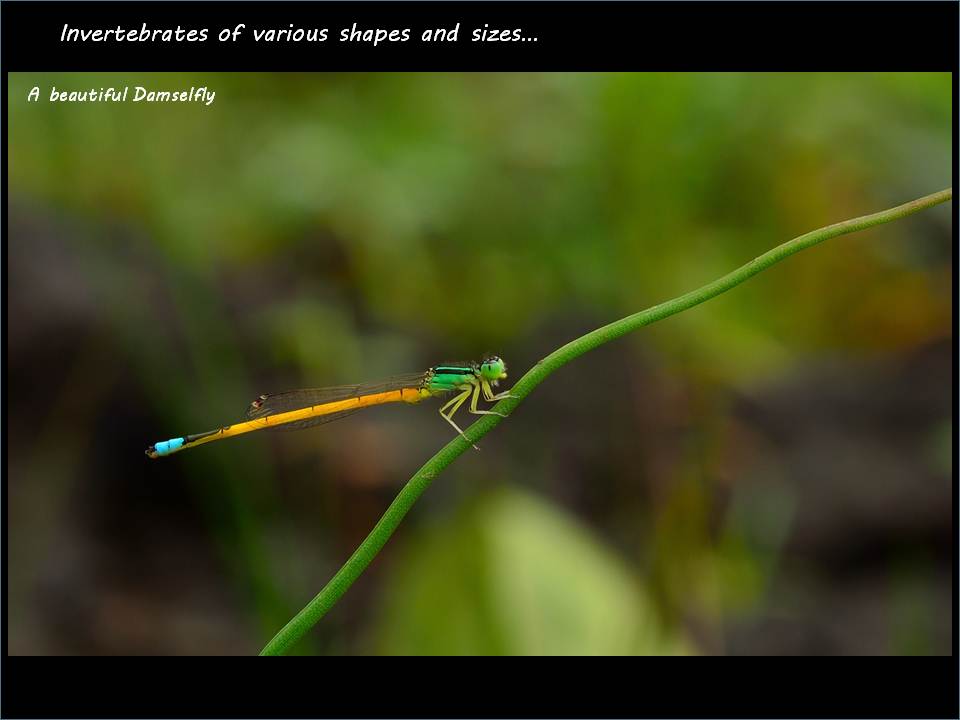
There were ants on the plants, feeding on plant sap as well as protecting them. There were snails slowly moving and feeding. There were spiders waiting for the prey to get closer to their trap. A huge Emperor’s Moth was found in a night walk. The highlight was to witness the Tiger Centipede, which could grow near to 1 foot, venomous and their bites are fatal to humans. These veracious predators are amazing to watch. There was a fishing spider which floats on the water surface, waits for a fish or tadpole to catch. A cricket was moulting, which is a process of removing old exoskeleton with a fresh one. A huge long horned beetle was watching us in a night trail. I was told it can deliver a painful bite. The mandibles were looking scary too.


Crustaceans – There were many crabs. The purple tree crab was plenty in number. We saw them feeding on moss grown over the trees. Also the spectacular red crab with yellow legs was the highlight. It looked like somebody did a tattoo work on its legs. We were even saying, Rig vedha was written on the legs. Many transparent crabs were found on the rocks of the ghats, feeding near the small water falls formed. The crabs were beautiful, and when we go closer, they protect them by covering their face with their chelae/claws.

Amphibians – many frogs were there in and around the place. We saw Bombay bush frog, common Indian toad, Amboli toad|Tiger toad, Fejarvarya sp., Cricket frogs and many tadpoles of Malabar Gliding frogs. In the stream, there were eggs laid by wrinkled frogs everywhere on the leaves, stem, rocks and stones. We decided to visit the place in the night. In the night, by the time we were nearing the stream, we heard loud bird calls. It was the call made by wrinkled frogs. They were everywhere. We found a male frog fertilizing the eggs. This frog looked different, than the usual frogs we see in cities. They had diamond shaped pupils, bird like calls, round shaped body and wrinkled skin.


There were almost 15 Prashad’s Geckos around the walls of our rooms. Also there were Day Geckos on trees and Brook’s House Gecko on the plateau.


On the night trail, a bamboo pit viper was found on a small shrub. It was in a curved position, ready to catch any prey like frog or lizard passing by. Also, the Malabar pit viper, was lying low on a tree root, for trying its luck. These snakes are classified as pit vipers. They are nocturnal, which means they are active and hunt prey in the night. They lie motionless at a comfortable place waiting for the prey to pass by. When a prey passes by, they catch them by striking. They are venomous, but no human fatalities are recorded so far. A bite to humans can cause local allergies. They have heat-sensing pits between the eyes and the nostrils using which they can sense the heat of their surroundings. These snakes use this as a tool to identify the prey and danger around them.


In the plateau, there was a huge pied belly shieldtail, feeding on a huge earth worm and finished in seconds, sucked it all just like a noodles. On an evening trail, a large scaled shieldtail was found feeding on an earth worm. Shieldtails are burrowing snakes, which have a distinct sliced like tail. They burrow under the ground and hide their burrow using their sliced tail, which acts as a shield.


There was a Striped Coral snake, which is a venomous snake found near the resort. These snakes feed on other small snakes and amphibians.

While walking inside the rainforest, a Beddome’s Keelback just slithered into a stone hide. These are non-venomous snakes. They display colors in their skin when threatened.  

Also, in the night trail, there 3-4 common vine snakes were found sleeping just at the edge of the branches, which was assumed as the safest place to roost.


Though the forest was lively, with lots of various life forms, with good weather, there was lots of plastic litter everywhere on the road sides.  These pollute the streams flowing in the forest which intern will pollute the rivers which we are dependent for drinking water. Also, we witnessed a beautiful Tiger Centipede killed by some fast driven vehicle on the road. It is hard to avoid animals getting killed by fast moving vehicles in the road.


 Tourism should support the nature, and both tourists and the Govt. are responsible to avoid pollution in any form – land, water, air and noise, at places like Amboli which are important for the ecosystem.


The slideshow can be found at:
http://www.youtube.com/watch?v=iBxwPgwjVFQ